

Residential real estate signals that help small businesses market smarter
Fort Island turns public real estate activity into practical marketing signals for local service businesses. Instead of guessing where demand might emerge, we use property and transaction data to identify places, timing, and segments that are more likely to need help.
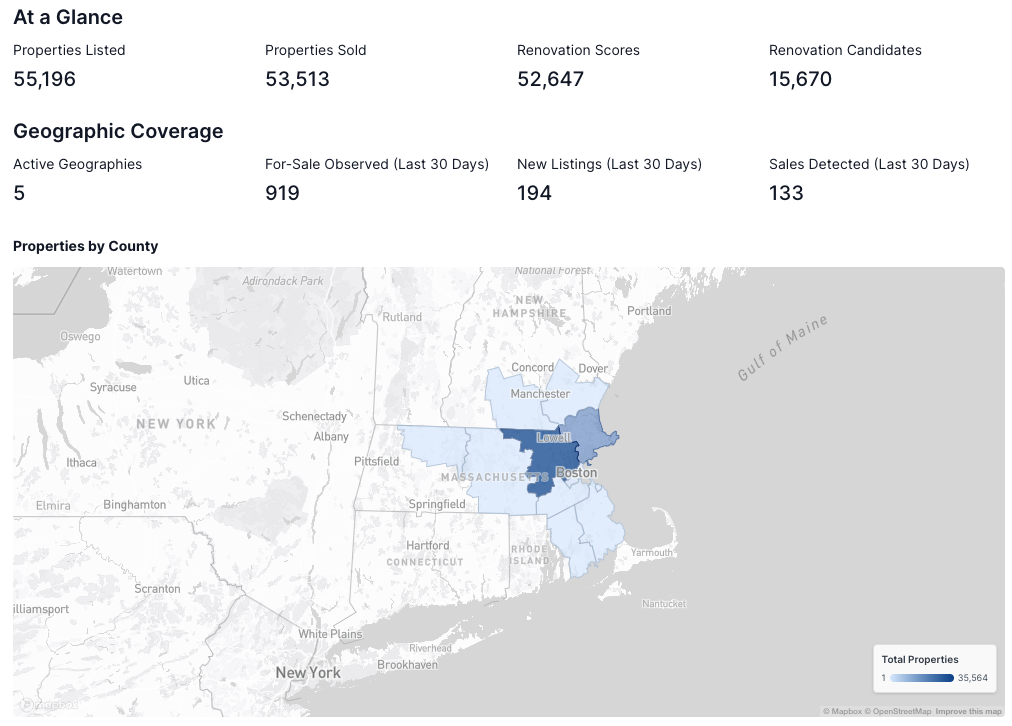
This page offers a high-level view of the signal model: the volume of properties observed, the geographies covered, and the subset of homes that appear most likely to be renovation or service candidates.
What you’re looking at
The visuals below summarize a working dataset built from publicly observable residential real estate activity. At a high level, the model tracks properties through a funnel:
listed → sold → scored → candidate
That progression helps narrow a very large universe of homes into a more actionable group for outreach, planning, and campaign targeting.
These signals are designed to support practical use cases such as:
direct mail targeting
territory planning
local market prioritization
lead generation for home-service businesses
campaign timing around move-in and renovation activity
How the signal funnel works
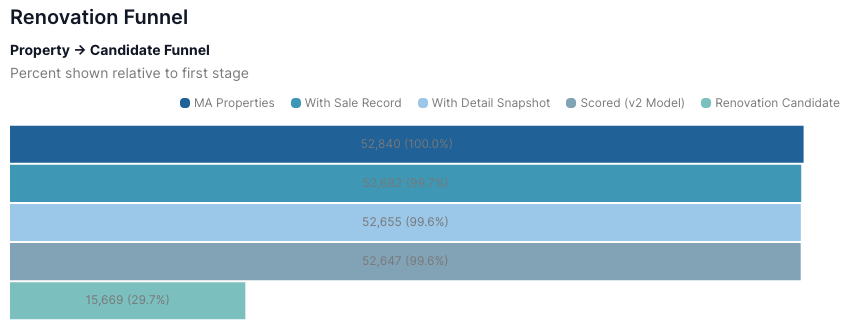
Not every sold home is equally relevant for outreach. The funnel below illustrates how properties move from broad market observation into a narrower set of likely candidates.
Each stage applies additional evidence or scoring logic to reduce noise and improve targeting. By the final stage, the objective is to identify homes that are more likely to represent timely demand for renovation, maintenance, or other home-related services.
This approach helps businesses focus effort where it is most likely to produce results, rather than spending blindly across an entire market.
These charts show a static view as of April 4th, 2026. A dynamic view is forthcoming. Please contact me directly for more current information!